07. Turning It into a DFA and Deciding Matches

In Chapter 06 we built an NFA from a pattern. From here we turn the procedures of Chapter 03 and Chapter 04 into code, and finally join it all up as a command.
What We Have at the Starting Point
Running through Chapter 06, the data left in our hands is like this.
>>> from automaton.nfa import build
>>> nfa = build("a(a|b)*bb")
>>> nfa.start, nfa.accept
(0, 6)
>>> for s in sorted(nfa.edges):
...     print(s, nfa.label[s], nfa.edges[s])
0 i [('a', 1)]
1 1 [(None, 2), (None, 4)]
2 2 [('a', 3), ('b', 3)]
3 3 [(None, 2), (None, 4)]
4 4 [('b', 5)]
5 5 [('b', 6)]
6 f []
What we hold is only 3 things.
| What we hold | Contents |
|---|---|
edges |
A listing, per state, of “the arrows leaving it”. None is ε |
start accept |
The entrance and exit states. Here, 0 and 6 |
label |
The names for display. 0 is i, 6 is f |
This is the output of Chapter 06, and the input of this chapter. From here, we build the form with no ε — the DFA.
3. Turning It into a DFA
The ε closure of Chapter 03, and the union of the destinations by a symbol. Both are nothing more than the definitions written down as they are.
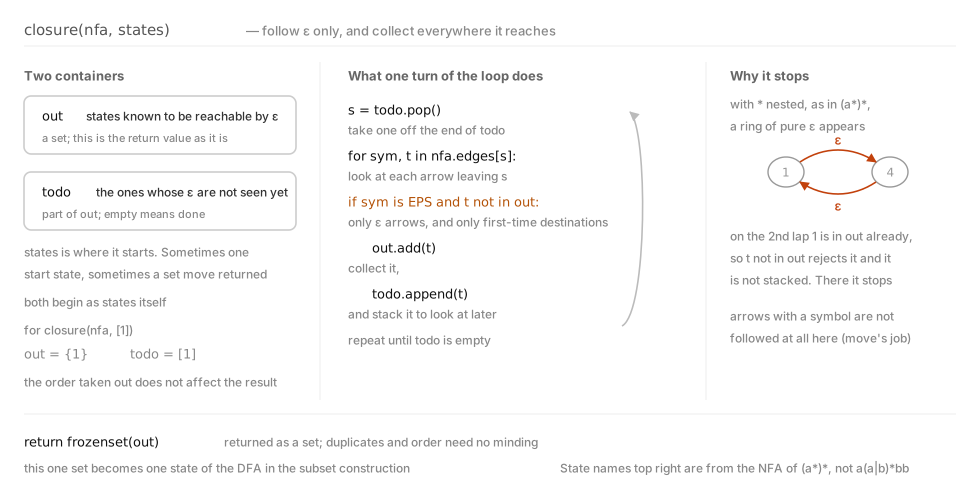
The function defined under the name closure starts from the states passed in its 2nd argument states,
collects every state reachable by ε, and puts them into out.
states is the starting point; sometimes it is a single start state, and sometimes it is the set returned by move.
Since out starts as set(states), the states we passed in remain in the result as they are.
Among that out, the ones whose ε destinations we have not looked at yet are todo.
todo is a part of out; it is not the unexamined states of the NFA.
Take one out of todo, and if its ε destination is one that has come out for the first time,
add it to both out and todo. out is for accumulating the answer, todo is for examining further on from there.
Once todo becomes empty, there is nowhere left that can be extended.
Calling closure(nfa, [1]) on the NFA for a(a|b)*bb stops in 3 moves.
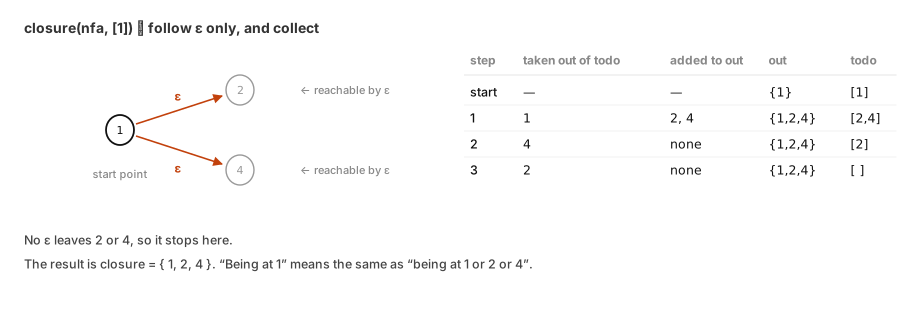
Since the same state is never pushed onto todo twice, it stops even in the case where we can come back to the original state by following ε transitions alone.
Following the ε transitions of a(a|b)*bb (1→2, 1→4, 3→2, 3→4) does not bring us back to the original, but
once * is nested, as in (a*)*, it becomes possible to go all the way round by ε alone, as in 1 → 4 → 1.
Even then, the destination on the 2nd lap is already in out, so it is not pushed onto todo, and it stops there.
def closure(nfa, states):
    """The epsilon-closure: every state reachable without reading any input."""
    out, todo = set(states), list(states)
    while todo:
        s = todo.pop()
        for sym, t in nfa.edges[s]:
            if sym is EPS and t not in out:
                out.add(t)
                todo.append(t)
    return frozenset(out)


def move(nfa, states, sym):
    """Where `sym` takes us from any of `states`, ignoring epsilon."""
    return frozenset(t for s in states for x, t in nfa.edges[s] if x == sym)
Both return a frozenset. This is Python’s set whose contents cannot be changed.
An ordinary set (set) like {1, 2, 4} can have elements added later, but a frozenset is fixed once made, and
in exchange for that it can be used as a dictionary key, or as an element of another set.
From here on, one state of the DFA becomes a “set of states of the NFA” itself.
Since we carry sets around as states and look up dictionaries like trans[(set, symbol)],
it has to be a set that does not change.
Looked at from the code side, what closure is doing is putting things in and taking them out of 2 containers.
move, conversely, follows not a single ε and advances by just one symbol’s worth.
Whichever state in the set the arrow leaves from, if the symbol matches then its destination is collected.
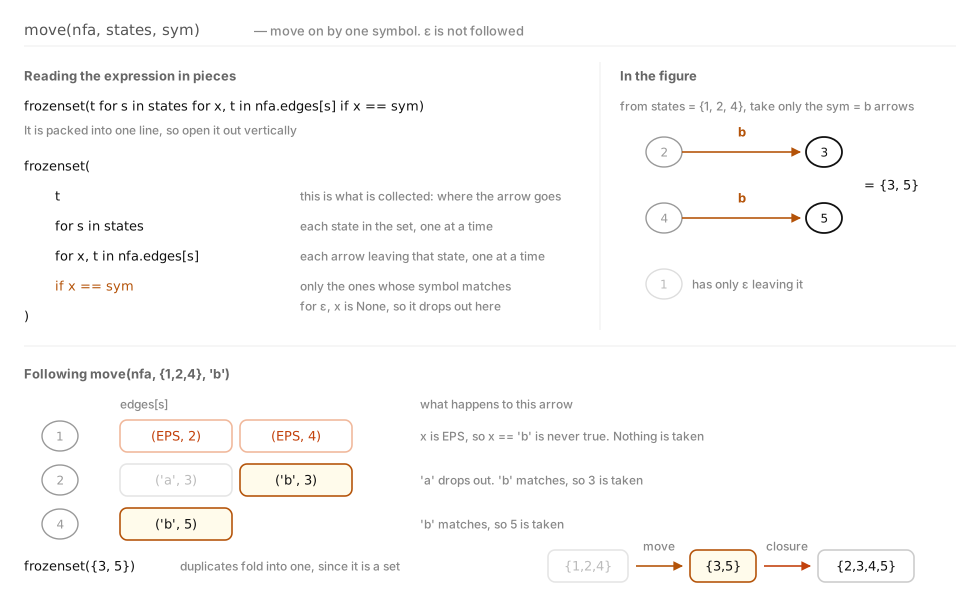
Advancing one step by a symbol and then widening by ε — that is, closure(move(...)) —
becomes one square of the from_nfa that follows.
Steps (1) through (3) of the build procedure become, just as they are, from_nfa.
In the same shape as closure, a set that has come out for the first time is added to both states and todo.
states is “the listing of the sets that have come out”, todo is “the sets whose destinations we have not examined yet”, and
once todo becomes empty, it is over.
def from_nfa(nfa):
    """Subset construction: one DFA state is a set of NFA states."""
    start = closure(nfa, [nfa.start])
    states, todo, trans = [start], [start], {}
    while todo:
        cur = todo.pop(0)
        for sym in symbols(nfa):
            nxt = closure(nfa, move(nfa, cur, sym))
            if not nxt:
                continue  # no transition on this symbol
            if nxt not in states:
                states.append(nxt)
                todo.append(nxt)
            trans[(cur, sym)] = nxt
    accept = {s for s in states if nfa.accept in s}
    name = {s: ",".join(nfa.label[k] for k in sorted(s)) for s in states}
    return DFA(states, start, accept, trans, name)
One state of the DFA is a frozenset (a set of states of the NFA) itself.
Since a set can be used directly as a key, the transition table is served by a single dictionary, trans[(set, symbol)].
That accept and name can hold sets directly is for the same reason.
The judgment “has this set already come out?”, nxt not in states, is merely comparing in order because states is a list,
and this one could be written with a set whose contents can be changed.
The departure set is the ε closure of nfa.start, and the accepting states are the sets that contain nfa.accept.
The former is step (1) of the build procedure of Chapter 03 itself; the latter is Chapter 03’s way of deciding that
“a set containing the final state of the NFA is an accepting state”, and they show up just as they are
in the first line and in the accept = ... line respectively.
Until todo becomes empty, we take out one set at a time and find the destination for each symbol.
The one taken out is cur, and the destination found is nxt.
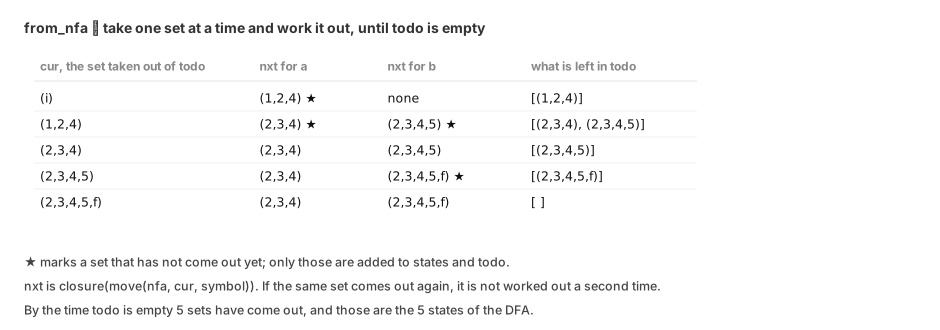
After going round 5 times todo becomes empty, and the sets — 5 of them — are all out. These are the states of the DFA.
Redrawn with circles and arrows, it is the same machine as the one we made by hand in Chapter 03.
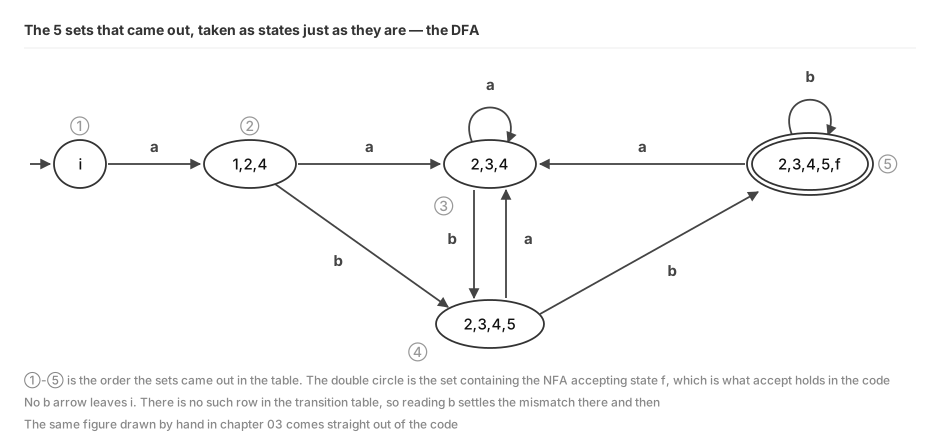
Let us confirm it in the form of a transition table too.
table prints its headers in Japanese, the way automaton/dfa.py
writes them: 状態 is the state, a による遷移先 is where a leads,
and なし means there is no transition.
>>> from automaton.nfa import build
>>> from automaton.dfa import from_nfa, table
>>> table(from_nfa(build("a(a|b)*bb")))
状態        a による遷移先  b による遷移先
i           1,2,4           なし
1,2,4       2,3,4           2,3,4,5
2,3,4       2,3,4           2,3,4,5
2,3,4,5     2,3,4           2,3,4,5,f
2,3,4,5,f*  2,3,4           2,3,4,5,f
4. Minimizing the Number of States
First, Shorten the Names
The same thing as rewriting (1,2,4) as 1 at the beginning of Chapter 04 is what
rename does. Left as sets they are long, and since minimization brings sets together further,
it becomes a “set of sets” and unreadable.
It may look like processing purely for the sake of readability, but it is not.
The minimize that comes after joins the names of the states it brings together into a new name, so
it presupposes the very fact that a state’s name is a string.
The result of from_nfa cannot be passed to minimize without going through rename.
In the order they came out, the start state is renamed i, the accepting state f, and the rest 1, 2, 3, ….
If there are 2 or more accepting states, the 2nd one onward become f2, f3, ….
When the start state is at the same time an accepting state, i takes priority and f is not attached.
For example, the states of a?b? are the 3 states i, f and f2, and i itself is also an accepting state.
a(a|b)*bb has 1 accepting state, and moreover it is different from the start state, so neither case shows up in the table.
The names are for display, and which states are accepting is held by a separate set called accept.
It is not accepting because its name is f. The * attached in the table is also stamped by looking at
that accept, not at the name.
def rename(dfa):
    """Replace each set of NFA states by a short name: i, 1, 2, ..., f."""
    name, k, a = {}, 0, 0
    for s in dfa.states:
        if s == dfa.start:
            name[s] = "i"
        elif s in dfa.accept:
            a += 1
            name[s] = "f" if a == 1 else f"f{a}"
        else:
            k += 1
            name[s] = str(k)
The remaining lines merely rebuild states, start, accept and trans using this correspondence table
(the variable name).
The shape of the machine does not change. What changes is only the names.
>>> from automaton.nfa import build
>>> from automaton.dfa import from_nfa, rename, table
>>> table(rename(from_nfa(build("a(a|b)*bb"))))
状態  a による遷移先  b による遷移先
i     1               なし
1     2               3
2     2               3
3     2               f
f*    2               f
This is the same as the table presented in Chapter 04.
From here on, i, 1, 2, 3 and f are the names after this renaming, and
they have nothing to do with the states of the NFA, so take care.
Repeating the Splitting
The repeated splitting of Chapter 04.
For each state, we make a pair of “by which symbols can it transition” and “which group does each of those destinations belong to”.
In the code we call this the key, and use it as the key of a dictionary called buckets.
Within the same group, states with the same key go into the same list of buckets, and
if the key differs they are separated into different lists. These lists become, just as they are, the next groups.
Since buckets is rebuilt inside for g in groups:, even if keys match across groups,
groups that have once been separated never merge back together.
Step (2) corresponds to the first half and step (3) to the second half, so in the implementation these 2 are brought together into a single key.
    # (1) split into the accepting states and the rest
    groups = [g for g in ([s for s in dfa.states if s in dfa.accept],
                          [s for s in dfa.states if s not in dfa.accept]) if g]
    while True:
        where = {s: i for i, g in enumerate(groups) for s in g}
        split = []
        for g in groups:
            buckets = {}
            for s in g:
                # (2) which symbols have a transition at all, and
                # (3) which group each of those transitions leads to
                key = tuple((sym, where[dfa.trans[(s, sym)]])
                            for sym in alphabet if (s, sym) in dfa.trans)
                buckets.setdefault(key, []).append(s)
            split.extend(buckets.values())
        if len(split) == len(groups):  # (4) nothing split any further
            break
        groups = split
The first line, groups = ..., is packed tight, so let us take it apart.
Writing the same thing split over 3 lines gives this.
accept = [s for s in dfa.states if s in dfa.accept]       # ['f']
other  = [s for s in dfa.states if s not in dfa.accept]   # ['i', '1', '2', '3']
groups = [g for g in (accept, other) if g]
The 1st line is the list collecting the accepting states, the 2nd line is the list collecting the rest, and
this is step (1), “divide into the final states and the rest”, itself.
The 3rd line merely lines those 2 up — except that if g is attached, and
an empty list is thrown away.
The reason it has to be thrown away is that one side can become empty.
In the DFA for a*, both of the 2 states are accepting states, so other becomes an empty list.
Leaving it as it is would produce a “group that has a number but no contents”.
As a result, groups becomes a list of groups, and one group is a list of state names.
For a(a|b)*bb, right after step (1) it looks like this.
groups = [['f'], ['i', '1', '2', '3']]
The 0th is the group of accepting states, the 1st is the group of the rest. These get split apart, and each single group that remains at the end becomes, just as it is, a single state.
where is the dictionary for looking up, from a state name, the number of the group that state is currently in —
that is, which position of groups it is in.
Right after step (1), its contents look like this.
where = {'f': 0, 'i': 1, '1': 1, '2': 1, '3': 1}
It means that only f is in group 0, and all the rest are in group 1.
The key is made using these numbers. State 3 goes to 2 by a and to f by b, so
looking up where['2'] and where['f'], its key becomes (('a', 1), ('b', 0)).
State 1 goes to 2 by a and to 3 by b, and both are in group 1, so (('a', 1), ('b', 1)).
Since the keys differ, 1 and 3 are separated into different groups.
State i has no destination by b, so its key becomes (('a', 1),), with only 1 element.
This is the part corresponding to step (2), “split by the kinds of transitions”.
If the groups get separated, the contents of where change too. The 2nd time it becomes
where = {'f': 0, 'i': 1, '1': 2, '2': 2, '3': 3}
and the keys get rebuilt too. That is why it is necessary to repeat until no splitting occurs.
Following how it actually finishes in 2 rounds gives this.
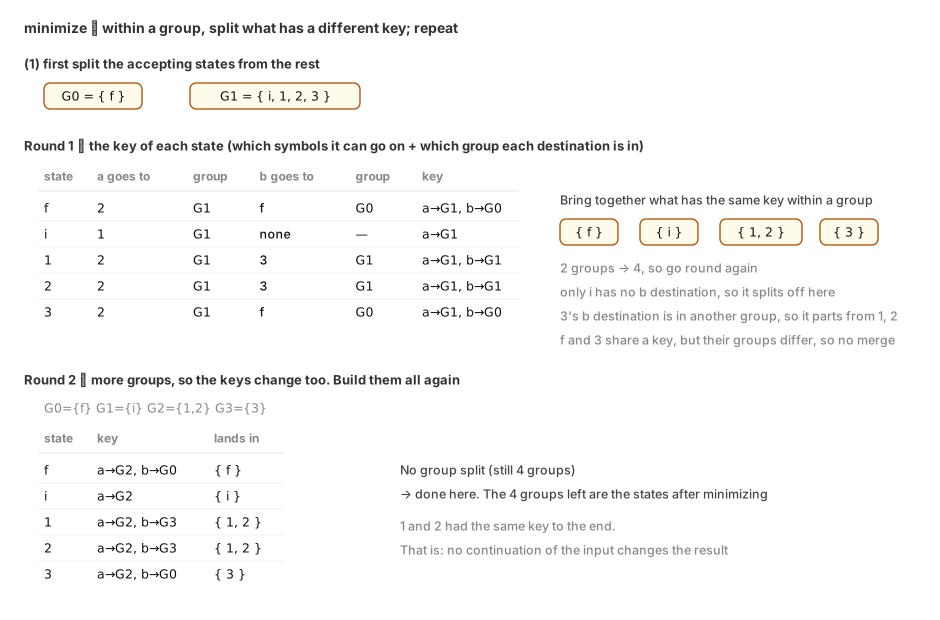
On the 1st round 2 groups became 4 groups, and on the 2nd round the number of groups did not change, so it stops.
Since “by which symbols can we go” is in the key, i, which has no destination by b,
is separated automatically on the first round. What corresponds to step (2) of Chapter 04
takes effect not as separate processing, but as part of the key.
Taking the 4 groups that remain as states, just as they are, gives this.
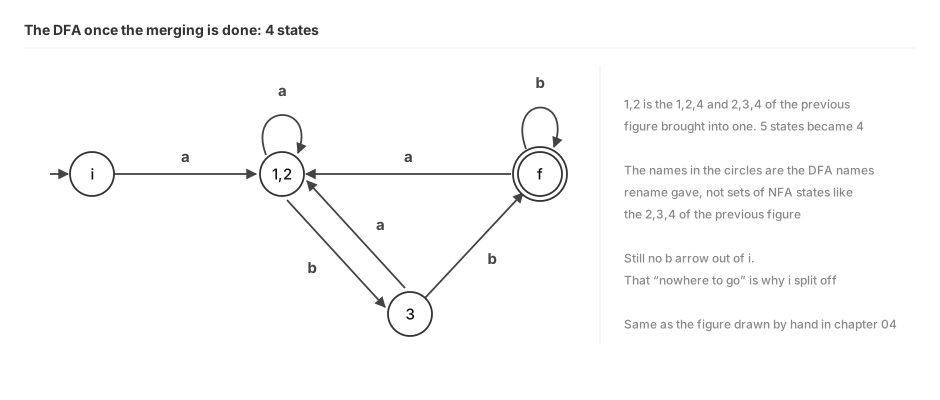
Let us confirm it in the form of a transition table too.
>>> from automaton.nfa import build
>>> from automaton.dfa import from_nfa, rename, minimize, table
>>> table(minimize(rename(from_nfa(build("a(a|b)*bb")))))
状態  a による遷移先  b による遷移先
i     1,2             なし
1,2   1,2             3
3     1,2             f
f*    1,2             f
5. Deciding a Match
It is nothing more than looking up the transition table one character at a time.
def accepts(dfa, text):
    """Does `text` match? Read it once, left to right, with no backtracking."""
    s = dfa.start
    for ch in text:
        if (s, ch) not in dfa.trans:
            return False  # no transition: the answer is already no
        s = dfa.trans[(s, ch)]
    return s in dfa.accept
There is neither searching nor backtracking. It finishes in time proportional to the input length.
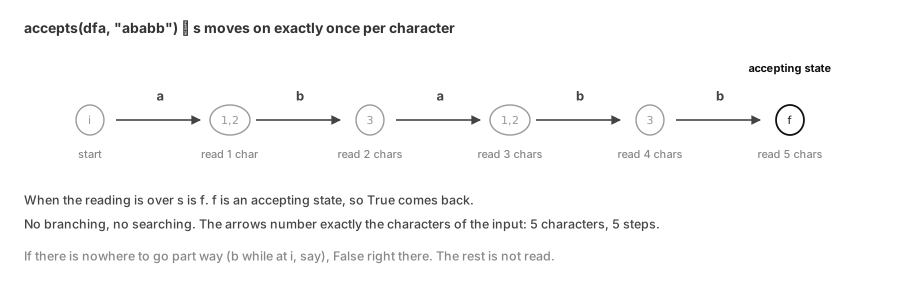
The variable s is rewritten exactly once per character.
It is the same route we followed by hand in Chapter 04.
6. Joining It Up into a Tool
All that is left is to call 1 through 5 in order.
    pattern, texts = argv[1], argv[2:]
    try:
        dfa = minimize(rename(from_nfa(build(pattern))))
    except ValueError as err:
        print(f"bad pattern {pattern!r}: {err}", file=sys.stderr)
        return 2

    if texts:
        for text in texts:
            print(f"{'match   ' if accepts(dfa, text) else 'no match'}  {text!r}")
        return 0

    for line in sys.stdin:
        line = line.rstrip("\n")
        if accepts(dfa, line):
            print(line)
    return 0
The assembly of the pattern happens only once at the start, and after that, however many lines come, it is only looking up the table.
Running It Through
Any pattern within the range decided in Chapter 05 passes through the same route.
$ python3 -m automaton 'a(a|b)*bb' ababb
match     'ababb'
$ python3 -m automaton '(ab)*c' ababc
match     'ababc'
$ python3 -m automaton 'a|bb' bb
match     'bb'
The ? added in Chapter 05 is the same.
It matches whether the u is there or not, and does not match if 2 of them follow.
$ python3 -m automaton 'colou?r' color colour colouur
match     'color'
match     'colour'
no match  'colouur'
That it works correctly is confirmed in tests/test_pipeline.py.
- That the result of each stage agrees with the figures and tables of the main part (the 9 arrows of the NFA, the 5 states after subset construction, the 4 states after minimization)
- That for a number of patterns, exhaustively enumerating short strings gives the same decision as Python’s
re
$ python3 -m pytest tests -q
If pytest is not installed, running the file directly runs the same checks.
$ python3 tests/test_pipeline.py
ok test_nfa_matches_the_figure
ok test_subset_construction_matches_the_figure
ok test_minimized_dfa_matches_the_figure
ok test_same_answers_as_the_regex_module
ok test_other_patterns
ok test_patterns_with_an_epsilon_cycle
ok test_bad_patterns_raise_value_error
With this, we have taken one full look at how a regular expression works. In Chapter 01 we wrote that “if the machine settles the destination on exactly one, it is enough to trace the input once”, and the path for mechanically building that machine from a regular expression has, up to here, all been joined together.
The regular expression engines we use day to day are also doing something close to this internally. Depending on the implementation, however, some do not build a DFA and instead follow the NFA while backtracking. That is the “try one, and if it fails, the other” approach we saw in Chapter 02. That one can handle features that a DFA cannot express, such as back references, but in exchange it can become extremely slow depending on how things are written. Turning it into a DFA means that does not happen — that was the meaning of what we did in Chapter 03 and Chapter 04.