05. Deciding Which Regular Expressions We Handle

In Chapter 01 through Chapter 04 we saw the procedure from NFA to DFA
with one example, a(a|b)*bb. Naturally, the next thing one wonders is “can the same thing be done with other patterns too?”
It can. What is more, a human does not have to draw the figures; the machine only has to walk through the same procedure. From here on, we build that as a script that actually runs.
The Range We Handle
What we dealt with in Chapter 01 through Chapter 04 were regular expressions that can be assembled out of just the following 3 things.
| Operation | Meaning | How to write it | Strings it matches |
|---|---|---|---|
| concatenation | line them up | abb |
abb |
union \| |
one or the other | a\|b |
a, b |
repetition * |
0 or more times | ab* |
a, ab, abb, … |
To these are added parentheses ( ) for changing precedence (as in (a|b)*).
Parentheses are not an operation; they are a notation showing how far one grouping extends.
These 3 are, in fact, the very operations that appear in the theoretical definition of a regular expression. Much of the notation we use day to day is no more than shorthand that can be rewritten into these.
| Commonly used notation | Written with these 3 |
|---|---|
a+ (1 or more times) |
aa* |
[abc] (any one of these characters) |
(a\|b\|c) |
a{2,3} (2 to 3 times) |
aa\|aaa |
One More: Adding ?
There is one thing that cannot be written with a combination of the 3 above: a? (0 times or 1 time).
This amounts to “a or nothing at all”, that is, a union with the empty string ε, a|ε, but
we have not provided a notation here for writing ε. So instead we add a?.
This is what was touched on in Chapter 02 as “it can be added as ⑤”.
| Operation | Meaning | How to write it | Strings it matches |
|---|---|---|---|
optional ? |
0 times or 1 time | ab?c |
ac, abc |
It is enough to add, as a 5th to the 4 rules we saw in Chapter 02, “make the body, and draw one ε from its entrance to its exit”.
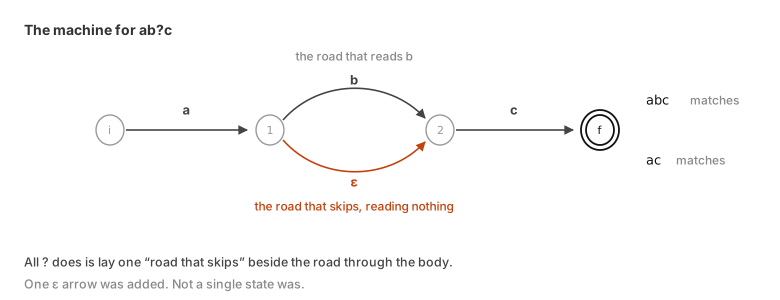
Going through the b arrow gives abc; skipping it with the ε arrow gives ac.
Whichever road we take we arrive at 2, so everything beyond that is the same.
Whereas repetition * draws 4 ε arrows, ? draws only the single “skip” one —
since there is no road back, the body is traversed at most once. We will see the details in Chapter 06.
And nothing else changes at all. Since only one more ε transition is added, the subset construction of Chapter 03 absorbs it as it is. Neither the DFA conversion, nor the minimization, nor the match decision needs rewriting.
Adding just one rule increases the notation we can handle — this fact shows that the procedure we saw in Chapters 01 through 04 is not a stopgap.
What We Do Not Handle
There is no . (any single character), no character class [ ], no count specifier {n,m}, and no anchor ^ or $.
As for back references (\1), they cannot be expressed by a DFA even in principle.
Characters other than (, ), |, * and ? are all treated, just as they are, as single-character symbols.
The empty pattern ('') and empty parentheses (()) are not accepted.
And any pattern within this range can be processed by the same procedure, whichever one comes along.
Nothing special is done for the sake of a(a|b)*bb.
Read the pattern, build an NFA, turn it into a DFA, reduce the number of states, look up the table. That is all.
The Overall Flow
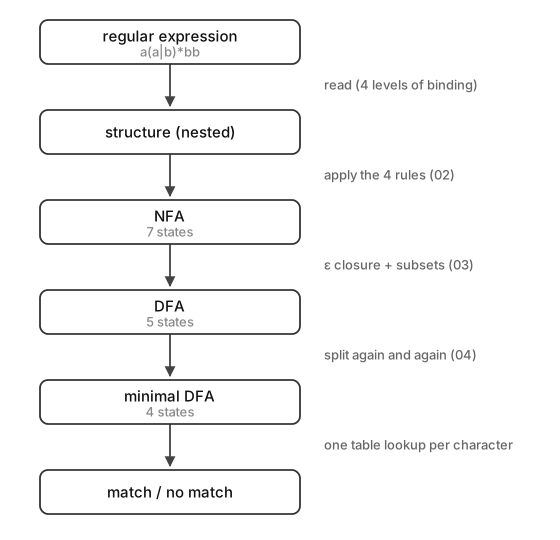
The procedure we saw in Chapters 01 through 04 becomes, one at a time, exactly one part each.
| Stage | Chapter where we saw the theory | Chapter where we see the implementation |
|---|---|---|
| Read the pattern | — | Chapter 06 |
| Build the NFA | Chapter 02 | Chapter 06 |
| Turn it into a DFA | Chapter 03 | Chapter 07 |
| Minimize the number of states | Chapter 04 | Chapter 07 |
| Decide the match | Chapter 04 | Chapter 07 |
“Read the pattern” is the only one with no corresponding chapter in 01 through 04. There, a human took in the structure of the regular expression by eye, so there was no need to explain it. Once we have a machine do it, that too has to be made into a procedure.
The language is Python. With 3.6 or later, it runs with the standard library alone.
Let’s Run It First
Here is what gets built. Hand it a pattern and some text, and it answers whether they match.
$ python3 -m automaton 'a(a|b)*bb' abb ab aabb ababb bb
match     'abb'
no match  'ab'
match     'aabb'
match     'ababb'
no match  'bb'
The decision is a match of the whole string; it does not search for partial matches.
Can It Really Handle All of Them?
To be able to say flatly “anything within this range”, grounds are needed.
In tests/, for a number of patterns we exhaustively enumerate short strings
and confirm that the decision comes out the same as Python’s re.
For a(a|b)*bb it is all strings of length 7 or less;
for a?, ab?, (a|b)?c, (a?b)* and others besides, it is all strings of length 5 or less.
Furthermore, for 400 patterns made by randomly combining the 4 operations
(119 of which contain ?),
we collated against re over all strings of length 5 or less (sequences of a, b and c),
and confirmed that not a single discrepancy comes out.
Then let us build it, in order, from Chapter 06 on.