02. Building an NFA from a Regular Expression

The NFA we saw in Chapter 01 was handed to us out of thin air. But it can be built mechanically from the regular expression. There are only 4 construction rules.
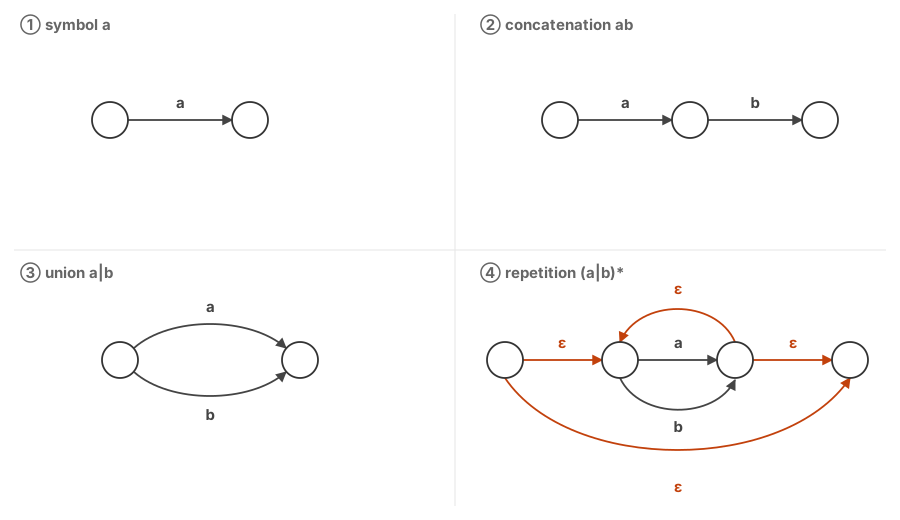
An arrow with a symbol on it means moving after reading one character of input; an ε arrow means being able to move without reading input. Every circle is a state.
The figure is drawn with a and b, but in the positions of these a and b
a part of the regular expression may go in as a lump.
In fact ④ is a drawing of (a|b)*, and the two circles in the middle together with the a and b that join them are ③ itself.
In other words, the 4 rules amount to a procedure for making a slightly larger NFA out of smaller NFAs as parts.
| Rule | What to do |
|---|---|
① symbol a |
Make 2 states and draw one a transition between them |
② concatenation ab |
Use the end state of a as it is for the start state of b |
③ union a\|b |
Draw the 2 arrows a and b from the same state, and bring their destinations together into a single state |
④ repetition (a\|b)* |
Place states before and after the repeated part a\|b, and draw 4 ε arrows as in the figure |
The 4 ε arrows of ④ correspond to 1→2, 1→4, 3→2 and 3→4 in the NFA of Chapter 01.
What each of these 4 arrows does is something we will see later, when we assemble the machine.
④ is the only rule that uses ε; ② and ③ get by with nothing more than bringing states together.
The regular expressions we handle here are taken to be the ones that can be assembled out of just these 4 rules.
That said, a 5th rule is added in Chapter 05. It is ? (0 times or 1 time), and
it too can be added in the same way. It does not appear in a(a|b)*bb, so we will not use it from here on.
In Thompson’s construction, the union of ③ also gets 2 new states with 4 ε arrows drawn, so the number of states grows further. ①, ② and ④ have the same shape as in Thompson. The reason only ③ places no states, letting both branches leave the same state and bringing their destinations together, is to make it agree with the figure in Chapter 01. Either way, the set of strings accepted does not change.
Building a(a|b)*bb
a(a|b)*bb is the concatenation of the 4 items a, (a|b)*, b and b.
Of these, (a|b)* is a repetition of (a|b), and (a|b) is a union of a and b.
We apply the rules in order, starting from the innermost part.
The names of the states are assigned in advance so as to match the figure that will come out.
Step 1: Apply ③ to a|b
Prepare 2 states, and from one to the other draw the 2 arrows a and b. This is figure ③ itself.
We call these 2 states 2 and 3.
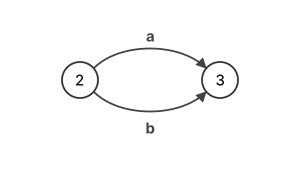
With either a or b, one character is read and we move from 2 to 3. This is the shape of “union”.
Step 2: Apply ④ to (a|b)*
The part made in step 1 (the a|b portion) is the body that gets repeated.
Add one state before it and one after it, calling the front one 1 and the back one 4. Then draw 4 ε arrows.
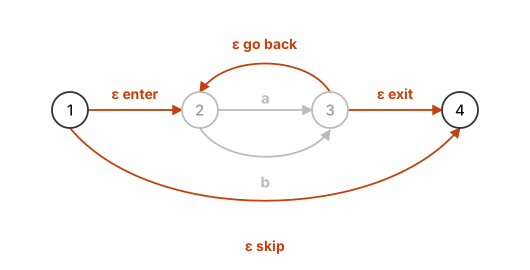
Grey is the body made in step 1. Each of the 4 orange arrows is in charge of entering the body, skipping the body (the 0-times case), going back from the end of the body (repeating once more), and exiting the body.
The meaning “0 or more repetitions” shows up in these 4 arrows just as it is. For 0 times, use “skip”; for once, “enter” → body → “exit”; for twice or more, use “go back” along the way.
With this, the part corresponding to (a|b)* is done. Its beginning is 1 and its end is 4.
Step 3: Make the leading a with ①, and join it with ②
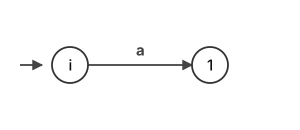
With ①, make 2 states and draw one a transition.
Then make its end state the same state as 1, the beginning of the part from step 2. This is the concatenation of ②.
The beginning state that is left over is the start state of the whole thing, so we call it i.
Step 4: Join the remaining b, b with ②
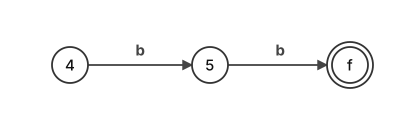
In the same way, take 4, the end of the part from step 2, as a beginning, draw a b transition, and go to a new state 5.
Then from 5 go by b to f. This last f is the accepting state of the whole thing.
The Finished Product
The transitions drawn come to 9 in total.
(i)-- a -->(1)        step 3
(1)-- ε -->(2)        "enter" from step 2
(1)-- ε -->(4)        "skip" from step 2
(2)-- a -->(3)        the union from step 1
(2)-- b -->(3)        the union from step 1
(3)-- ε -->(2)        "go back" from step 2
(3)-- ε -->(4)        "exit" from step 2
(4)-- b -->(5)        step 4
(5)-- b -->((f))      step 4
Drawn as a figure, it is the very NFA presented in Chapter 01.
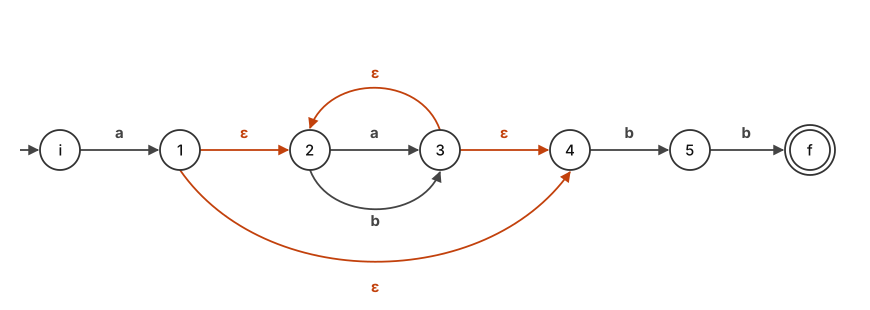
The state names i, 1, 2, ..., f were assigned in the order in which the edges are followed from the start state.
In other words, the NFA of Chapter 01 is the result of applying these 4 rules to a(a|b)*bb.
As long as you have a regular expression, an NFA can always be built.
The Problem with This NFA
The NFA built this way has 4 ε transitions: 1→2, 1→4, 3→2 and 3→4.
This becomes a nuisance, just as it is, when we run the machine.
Let us feed in abb and follow along in order from i.
i --a--> 1    a single path up to here
1 --ε--> 2 or 4?   it splits into 2 moves without reading input
If we choose 4, we read b, b, arrive at f, and can accept.
If we choose 2, we read b and advance to 3, and from there it splits again into 2 or 4.
Because the branching happens regardless of where in the input we are reading, which one is correct cannot be known on the spot. It can only be known after reading all the way to the end. Implemented naively, we try one and if it fails go back to the other — backtracking is required. The branches also nest, so as the input gets longer the combinations to try increase sharply.
What we want is a machine in which the destination is settled on exactly one from the state we are in now and the next single character. Then there is no way for it to branch, and it is enough to trace the input once from the top.
So then, how can we remove the ε transitions and get into that form? That is the subject of Chapter 03.