English · 日本語
📖 For the best reading experience with properly rendered math and figures, see the GitHub Pages version: https://t-ishii66.github.io/tiny-llm/
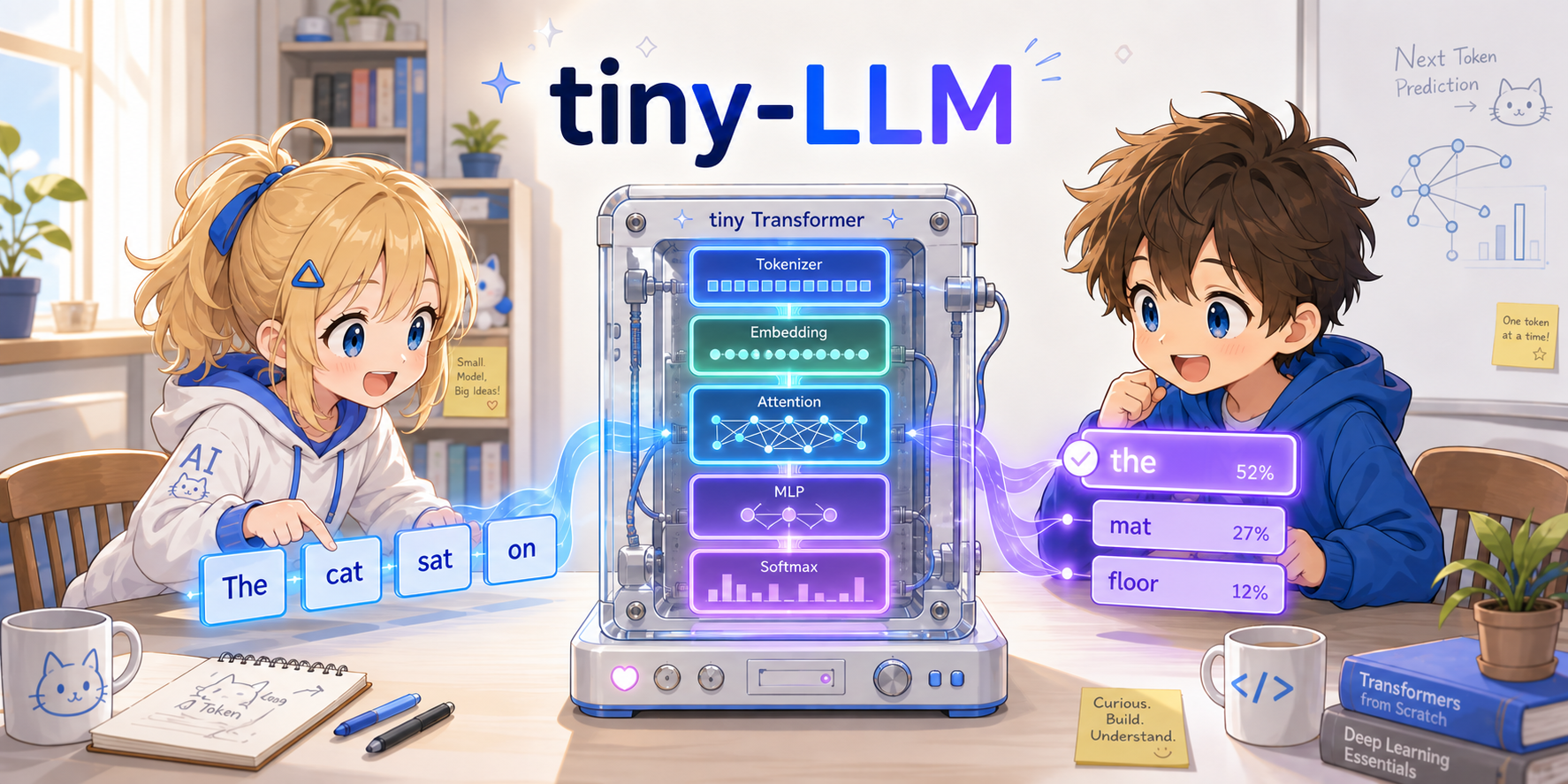
tiny-LLM from scratch
A single-file Transformer implementation for learning, in the most concise Python code possible, the algorithms at the core of large language models (LLMs) like GPT — Self-Attention, Query/Key/Value, Multi-Head Attention, and next-token prediction.
About This Project
This is a GPT-style Transformer pared down to the bare minimum. The model body fits in one file (tiny_llm.py, about 140 lines of executable code; the instruction tuning covered in Chapter 5 adds about 100 more lines in tiny_llm_instruct.py), and it trains on a toy corpus in a few seconds. The forward pass is written by hand, and only the backward pass is left to PyTorch’s autograd.
"the cat sat on" → Transformer → "the" (predicting the next word)
What You Can Learn
- Embedding: how words are converted into vectors
- Positional Embedding (learned): how position information is embedded
- Self-Attention (Q, K, V): how tokens direct attention at each other
- Multi-Head Attention: how multiple attention patterns are run in parallel
- Causal Masking: how future tokens are hidden during training
- Feed-Forward Network: how each token is transformed individually
- Residual Connections and Layer Norm: how deep networks are made trainable
- Training with Cross-Entropy Loss: how the model learns to predict the next word
- Text Generation: how a trained model generates text one token at a time
Simplifications
This is a learning tool, not a production-grade model. The main simplifications are as follows.
| Aspect | tiny-LLM | Production LLMs |
|---|---|---|
| Tokenizer | whitespace split (word = token) | BPE / SentencePiece (subword) |
| Vocabulary | 10 words | 50,000 to 200,000+ tokens |
| Number of parameters | about 68,000 | billions to trillions |
| Training data | 40 tokens drawn from a 10-word vocabulary (a total count including repeats of the same word) | trillions of tokens |
| Generation | Greedy (argmax) | sampling with temperature, top-k, top-p |
| Dropout / regularization | none | Dropout, weight decay, etc. |
| Core algorithm | the same | the same |
Why It’s Still Useful
Even with all these simplifications, the core algorithms implemented here are used as-is in state-of-the-art models such as GPT and LLaMA. The difference is mainly one of scale, while the underlying structure is shared. Once you understand this code, Q/K/V projections, Scaled Dot-Product Attention, the Causal Mask, Residual Connections, Layer Normalization, and autoregressive generation — all of these carry over directly to practical Transformer implementations, so it becomes a foundation for reading real-world code.
Quick Start
uv run --with torch tiny_llm.py
If you don’t have uv installed, see the installation instructions in Tutorial Step 1.
Running the script displays the training progress and the generation results (the numbers vary slightly from run to run).
epoch   20  loss=1.9469
epoch   40  loss=1.5257
...
epoch  200  loss=0.1147

prompt: "the cat sat on"
output: the cat sat on the mat . the dog sat on the log .
        the cat saw the dog . the dog saw the
Documentation
| Document | Content |
|---|---|
| Chapter 1: Data Preparation | Building the vocabulary, tokenization, and how to make training data |
| Chapter 2: Transformer | Embedding, Self-Attention, FFN, and the whole Forward Pass |
| Chapter 3: Training | Cross-Entropy Loss, backpropagation, and parameter updates |
| Chapter 3 Supplement: Gradient Math | Derivatives, partial derivatives, and the chain rule explained with concrete numbers |
| Chapter 4: Text Generation | Next-word prediction, Greedy Decoding, and comparison with real LLMs |
| Chapter 5: Instruction Tuning | Alpaca format, Response masking, and how to build an instruction-following LLM |
Tutorial
| Tutorial | Content |
|---|---|
| Step 1: Setup and Running | Setting up the environment, running the code, checking the output |
| Step 2: Exploring the Data | Check tokenization and the contents of the training data with your own eyes |
| Step 3: Peeking Inside the Transformer | Visualize the attention weights and embedding vectors |
| Step 4: Experiments and Modifications | Experiment by changing parameters and changing the corpus |
| Step 5: Try Instruction Tuning | Run Alpaca-style Instruction Tuning in 3 stages and feel the limits of rote memorization |
Credits
- Project Planning: t-ishii66
- Architecture Design: t-ishii66
- Programming: Claude Opus 6, t-ishii66
- Documentation: Claude Opus 6, GPT 5.3 Codex, t-ishii66
- Review: t-ishii66
- English translation: Claude Opus 6, GPT 5.3 Codex
- Release date: 2026/9/19
- Version: 2.0.0
Copyright(C) 2026 t-ishii66. All rights reserved.